
Electrical Panel & Enclosure Protection
Electrical Panel & Enclosure Protection
Self-Activating Fire Protection for High-Risk Electrical Enclosures
FOT FIRE CONTROL is a manufacturer of advanced Thermoresponse Temperature-Sensing Automatic Fire Suppression Systems, engineered to provide rapid and reliable fire detection and suppression within electrical panels, control cabinets, machinery enclosures, and other enclosed high-risk equipment.
The Thermoresponse system combines automatic heat detection and suppression activation in a compact, reliable solution. It does not require external electrical or pneumatic power to initiate detection and suppression, making it particularly suitable for protecting critical electrical and industrial equipment where early fire intervention is essential.
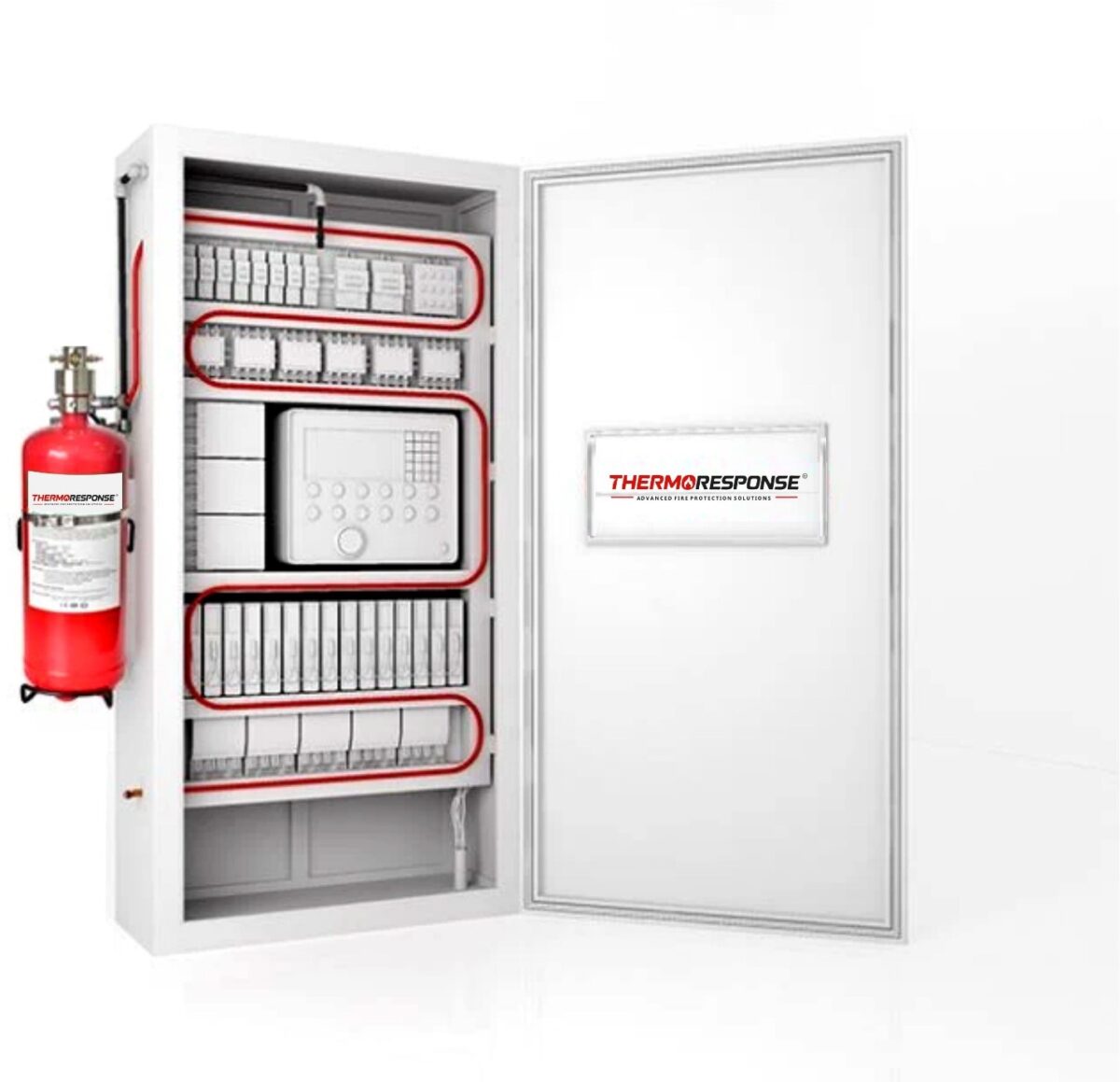
The system utilizes a flexible, heat-sensitive detection tube strategically installed within the protected enclosure. When the tube is exposed to a predetermined activation temperature, the section subjected to the highest heat ruptures, initiating the suppression process and releasing the extinguishing agent within seconds.
THERMORESPONSE SYSTEM CONFIGURATIONS
Direct Thermoresponse System
In the Direct Thermoresponse System, the heat-sensitive tube performs both fire detection and suppression-agent discharge functions.
When the tube is exposed to intense heat or direct flame, it ruptures at the point of highest temperature. The resulting opening allows the suppression agent to discharge directly onto the fire source.
The direct configuration is particularly suitable for small and localized hazards, including:
- Electrical control cabinets
- Electrical panels
- Control boxes
- Small machinery enclosures
- Localized electrical equipment
- Compact equipment compartments
By discharging the suppression agent directly at the point of detection, the system provides rapid localized fire intervention.
Indirect Thermoresponse System
In the Indirect Thermoresponse System, the heat-sensitive tube functions exclusively as the fire detection and activation mechanism.
When the tube reaches its activation temperature and ruptures, the resulting pressure change activates the system valve. The suppression agent is subsequently discharged through dedicated copper or stainless-steel pipework and strategically positioned discharge nozzles.
The indirect configuration is particularly suitable for:
- Larger electrical cabinets
- Control rooms and equipment enclosures
- Switchgear compartments
- Generator and machinery compartments
- Larger industrial equipment
- Enclosures requiring multiple discharge nozzles
This configuration allows the suppression agent to be distributed through multiple discharge points for more comprehensive protection.
SUPPRESSION AGENTS
FOT FIRE CONTROL Thermoresponse systems can be engineered with a range of approved fire suppression agents, selected according to the specific hazard, equipment type, enclosure volume, environmental conditions, and applicable fire protection requirements.
FM-200® – HFC-227ea
A clean gaseous suppression agent suitable for protecting sensitive electrical and electronic equipment. It leaves no residue following discharge and is designed for rapid suppression of fires within appropriately designed enclosures.
FK-5-1-12
A clean-agent suppression solution designed for applications where protection of sensitive electrical and electronic equipment is required. It is non-conductive and leaves no residue after discharge.
High-Pressure CO₂
Carbon dioxide suppression systems can be applied to suitable enclosed electrical and industrial hazards where the system can be engineered with appropriate personnel safety measures, enclosure requirements, ventilation controls, and warning systems.
Inert Gas
FOT FIRE CONTROL can also configure Thermoresponse systems using inert gas agents such as:
- IG-100 – Nitrogen
- IG-01 – Argon
- IG-55 – Argon/Nitrogen
- IG-541 – Nitrogen/Argon/CO₂
Inert gas systems extinguish fire by reducing the oxygen concentration within the protected enclosure to a level that does not support combustion while maintaining an appropriate safety margin for the protected application.
The selection of suppression agent is determined through appropriate hazard assessment and system design.
TYPICAL APPLICATIONS
FOT FIRE CONTROL Thermoresponse systems are designed for localized and enclosed fire hazards, including:
- Electrical panels
- Electrical control cabinets
- MCC panels
- Switchgear enclosures
- Control panels
- Distribution boards
- Electrical and instrumentation cabinets
- PLC control cabinets
- Machinery control cabinets
- Generator control panels
- Telecommunications equipment
- Electronic equipment enclosures
- Industrial machinery enclosures
- Battery and equipment compartments where specifically engineered
- Other enclosed high-risk electrical and industrial equipment
SOURCE-LEVEL FIRE PROTECTION
Electrical fires can develop rapidly inside enclosed cabinets and equipment, often involving cables, terminals, electrical connections, circuit boards, relays, contactors, transformers, and other heat-generating components.
The Thermoresponse detection tube is installed within the protected enclosure and positioned close to potential fire hazards.
This enables the system to detect abnormal heat inside the enclosure, initiate suppression rapidly, and help prevent a developing fire from spreading to adjacent components or surrounding equipment.
KEY FEATURES AND BENEFITS
- 24/7 automatic fire protection
- Rapid temperature-based fire detection
- Fast automatic suppression activation
- No external electrical power required for activation
- No pneumatic power required for activation
- Direct and indirect system configurations
- Compact and flexible installation
- Low maintenance requirements
- Reliable operation in enclosed equipment
- Detection and suppression at the fire source
- Multiple suppression-agent options
- Suitable for sensitive electrical and electronic equipment
- Flexible heat-sensitive detection tubing
- Can interface with conventional and addressable fire alarm systems where required
- Helps minimize equipment damage
- Reduces potential operational downtime and business interruption
- Suitable for new installations and selected retrofit applications